Malaga to Seville: Train vs Bus vs Day Trip
Compare the train, bus and a day trip from Malaga to Seville, including journey times, booking advice and whether one day is enough.
By the Travel Saving Hub team · Updated 19 Oct 2026

The short version
Malaga to Seville is a manageable journey, but the best option depends on whether you value time, price or flexibility. I’d usually take the train, particularly for a day trip, although the bus can make sense when the fare is noticeably lower.
The short version
- Take the Renfe train if you want the quickest and most predictable journey, at roughly 2 hours between Málaga María Zambrano and Seville Santa Justa.
- Check Alsa if keeping the cost down matters more than arriving quickly. Buses generally take around 2.5–3 hours and can be affected by traffic.
- A Seville day trip from Malaga is possible, but it normally gives you around 4–5 hours in the city rather than a relaxed full day.
- Book the Real Alcázar and Cathedral ahead of time if you are visiting for one day, because queuing can consume a large part of your available sightseeing time.
Malaga and Seville are close enough to combine, but not so close that the journey disappears. The useful question is not simply how to get from Malaga to Seville. It is whether you want to spend more on speed, accept a slower road journey to save money, or compress Seville into one carefully organised day.
This guide compares the train, bus and day-trip approach. I’ve used Renfe’s official information for the train journey and Alsa’s published timetable and pricing information for the bus. Prices change with booking date, departure time and promotions, so I’m not giving a pretend “typical fare” here. That is generally more useful than quoting a number that vanishes when you try to book it.
Train Malaga to Seville: the quickest option
Direct high-speed services connect Málaga María Zambrano with Seville Santa Justa in about 2 hours, according to Renfe’s official site. Depending on the exact service and stops, the journey is roughly 2 hours to 2 hours 15 minutes.
For me, the train is the easiest choice because both stations are practical starting and finishing points. Málaga María Zambrano is close to the city centre, while Seville Santa Justa is connected to the rest of Seville by local buses and taxis. You avoid the uncertainty of motorway traffic, and the journey is long enough to sit down, read or stare out of the window without feeling as though you have lost an entire day.
Renfe services can include Avant or AVE trains, depending on the timetable and ticket offered. The exact fare varies according to how early you book, the departure time and any available promotion. Renfe’s official booking channels are the sensible place to check the current options rather than relying on an old price guide.
The main drawback is that the cheapest tickets may be tied to a particular departure. That is not a problem if you are travelling directly to Seville, but it matters more on a day trip. A late return can be useful for sightseeing, yet it also means arriving back in Malaga after a fairly long day.
Bus Malaga to Seville: usually cheaper, less predictable
Alsa operates more than 13 daily services between Malaga and Seville, with journey times generally around 2.5–3 hours, according to Alsa’s published route information. That makes the bus a credible alternative rather than a last resort.
The bus is usually cheaper than the high-speed train, although the actual Alsa Málaga Seville price depends on when you book and which departure you choose. I’d check the bus fare before buying a train ticket, particularly if you are travelling alone or have flexible timing. The difference can be worthwhile for a longer Spain itinerary where several small transport decisions start adding up.
The trade-off is the road. The bus may be comfortable enough, but it is exposed to traffic in a way the train is not. A scheduled 2.5-hour journey can become less convenient if the motorway is busy, which is especially irritating when you have a timed Alcázar entry or a return connection to catch.
Buses can suit travellers staying somewhere that is easier to reach from the coach station than from a railway station. They also offer more daily departures in some schedules. I would still check the live timetable on the day of travel and leave some margin before any fixed booking in Seville.
Seville day trip from Malaga: is one day enough?
A day trip from Malaga to Seville is feasible, but it is a fairly concentrated way to see the city. If you take an early train out and a late train back, the total day can run to roughly 9–11 hours door to door. The research for this route suggests that this normally leaves around 4–5 hours for exploring Seville’s centre.
That is enough to see a few major sights, not enough to understand every corner of the city. I’d treat it as an introduction rather than a proper Seville visit.
A workable plan would be to arrive at Seville Santa Justa, travel into the centre and visit the Real Alcázar first if you have a timed entry. From there, the Cathedral is close by. You could then walk towards Plaza de España and Maria Luisa Park, although fitting all four places into the same day means keeping an eye on the clock rather than wandering wherever looks interesting.
The Real Alcázar and Cathedral are the awkward parts of a short visit. Both can attract queues, and the Alcázar is particularly difficult to leave until the last minute during busy periods. Booking timed-entry tickets in advance is worth considering, even if it makes the day slightly less spontaneous.
The train works better than the bus for this plan because saving roughly 30 minutes or more each way gives you extra time in Seville and reduces the risk of traffic disrupting the return. A bus day trip can still work, but I’d only choose it if the timetable and fare were clearly better for the particular date.
Malaga to Seville prices and journey times
The main figures are fairly straightforward, while the pricing is not.
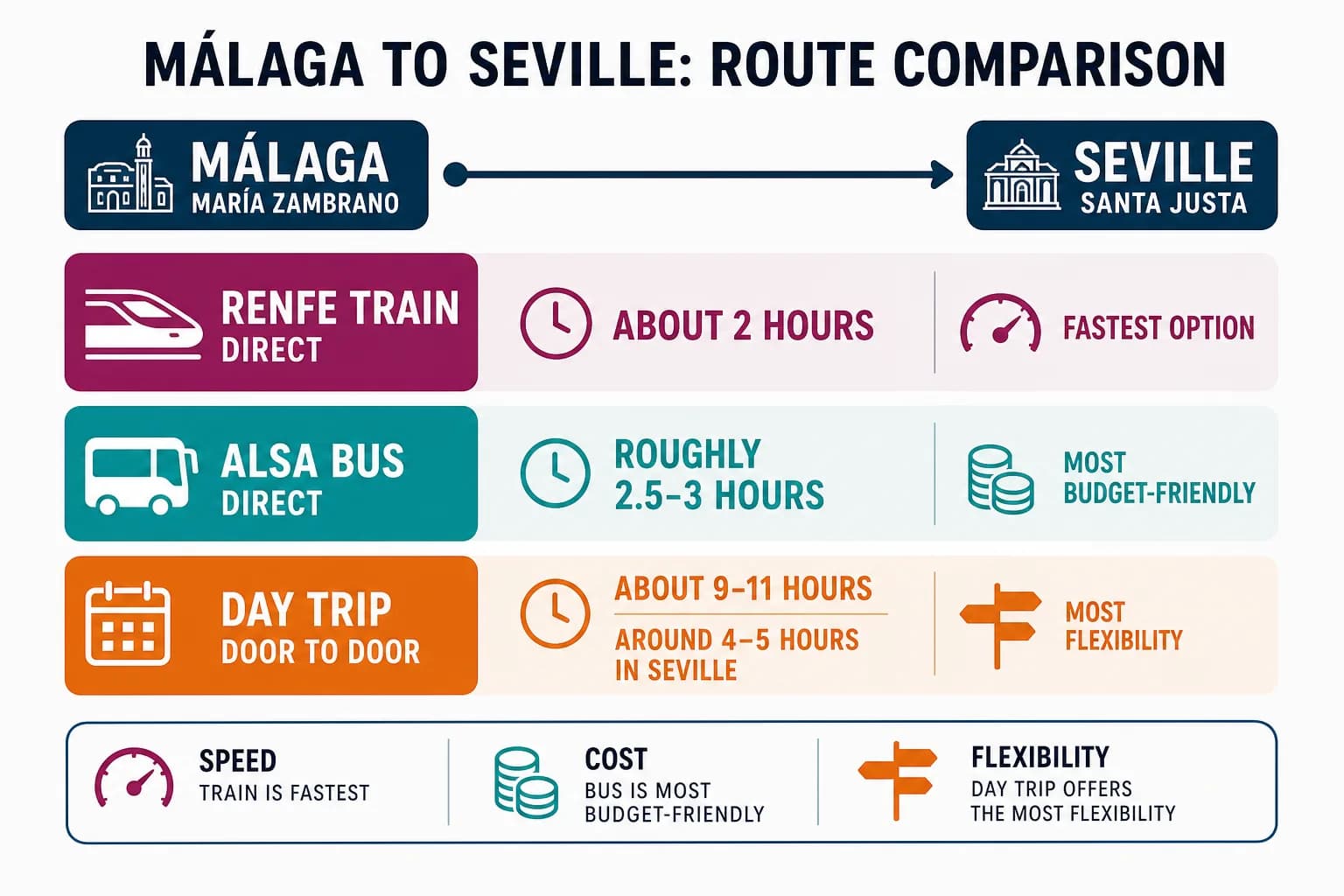
About 2 hours
Direct Renfe train
2.5–3 hours
Alsa bus
About 9–11 hours
Day trip door to door
Around 4–5 hours
Likely time in Seville on a day trip
Renfe train prices are variable. Earlier bookings and promotions can reduce the fare, but the research does not give a fixed current price range, so I would compare the exact departures on Renfe’s official site rather than plan around a number.
Alsa fares also vary by departure and booking date. The bus is usually the lower-cost choice, but “usually cheaper” is not the same as a guaranteed saving. Check both operators before deciding, especially outside peak travel periods.
For a day trip, remember that the ticket cost is only part of the calculation. A cheap bus can become less attractive if it arrives later, returns earlier or adds enough uncertainty that you need to avoid timed activities. The train often earns its extra cost simply by giving you a more usable day.
What I’d choose for each type of traveller
If I wanted to make the most of one day, I’d choose the train. The journey from Malaga to Seville is short enough by high-speed rail that the day remains tiring but realistic. I’d book the earliest practical departure, reserve the Alcázar in advance and leave the return journey late enough to allow for lunch and a walk through Plaza de España or Maria Luisa Park.
If I were travelling on a tighter budget, I’d compare Alsa first and then check Renfe for promotions. The bus is a sensible option when the fare is clearly lower and the timetable does not force awkward compromises. I would not book a timed attraction immediately before the planned bus arrival.
If I had more than one day, I would stay in Seville instead of making the return journey on the same day. Seville rewards a slower pace: an evening walk, a later meal and the chance to see the centre before the daytime sightseeing crowds arrive. A day trip is useful for sampling the city, but it is not the best way to experience it if you can spare a night.
Compare both operators before booking
Renfe is faster, but Alsa is often cheaper. Check the actual departure times and fares for your date rather than assuming one option always wins.
Protect your sightseeing time
For a day trip, take an early outbound service and avoid booking an attraction so close to arrival that a small delay ruins the plan.
Book the Alcázar ahead
Timed entry is particularly useful when you have only 4–5 hours in Seville. Queuing is a poor use of a short visit.
Bottom line: train, bus or day trip?
The train is the best overall balance for most travellers going from Malaga to Seville. Direct Renfe services take about 2 hours, arrive at Seville Santa Justa and make the route practical for a day trip without relying on motorway traffic.
The bus is the budget option. Alsa runs more than 13 daily services, with journeys around 2.5–3 hours, and can be the right choice when the fare is lower and your schedule is flexible.
A Seville day trip from Malaga is worth doing if Seville is a priority and you accept that the day will be tightly planned. You can cover the Alcázar, Cathedral, Plaza de España and Maria Luisa Park in outline, but you will not have much room for delays or aimless wandering. If you can stay overnight, I would do that instead.
For more ideas once you arrive, see our Seville destination guide. You can also use the Spain hub to plan the rest of an Andalusian itinerary.