Bangkok to Koh Samui: Train, Bus, Ferry or Flight?
Compare Bangkok to Koh Samui flights, sleeper trains, buses and ferries by price, journey time and practical convenience.
By the Travel Saving Hub team · Updated 19 Oct 2026
The short version
I’ve compared the main ways to travel from Bangkok to Koh Samui: a direct flight, the train via Surat Thani, and bus-and-ferry routes through Don Sak. The cheapest option depends on the date and operator, but the practical differences are fairly consistent.
The short version
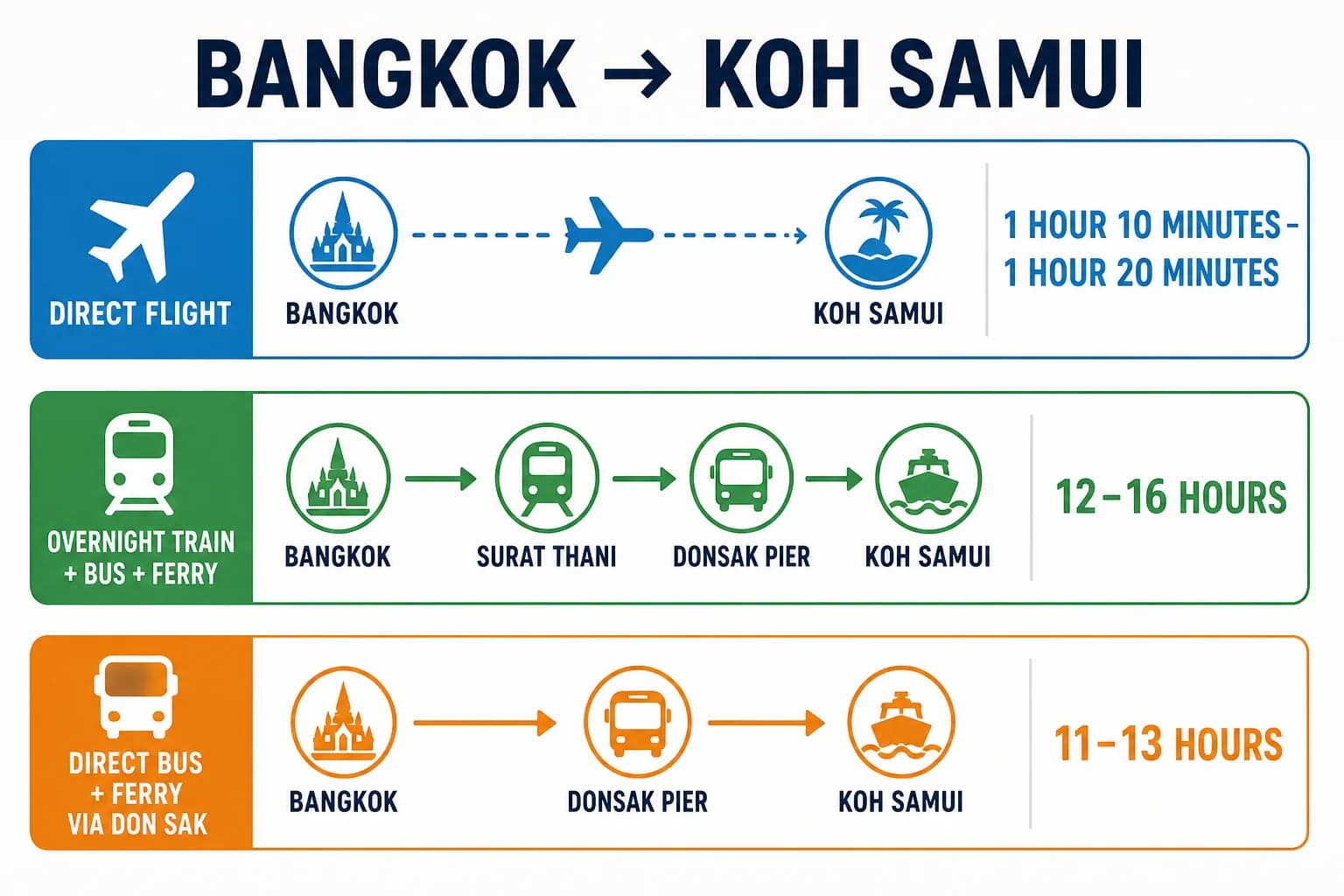
- A direct Bangkok to Koh Samui flight takes about 1 hour 10 minutes to 1 hour 20 minutes and is usually the simplest option.
- The train to Surat Thani followed by a bus and ferry usually takes 12–16 hours in total, with sleeper options available.
- A bus-and-ferry route via Don Sak commonly takes 11–13 hours and is usually the budget-friendly choice.
- Land-and-sea travel has more connections, and ferry conditions can affect the final part of the journey.
The cheapest ticket is not automatically the cheapest journey in practice. Airport transfers, baggage, an extra hotel night and the inconvenience of separate connections can change the calculation. I’d compare the complete route rather than only the first fare shown in a search result.
Bangkok to Koh Samui flights: fastest and simplest
For most travellers, a direct flight is the least complicated way to reach Koh Samui from Bangkok. Bangkok Airways is the primary operator on the route, flying directly to Samui Airport. The flight itself typically takes 1 hour 10 minutes to 1 hour 20 minutes.
The trade-off is the fare. The research for this guide puts flight prices at roughly ฿2,600–฿6,000 or more, depending on the day and whether a sale is available. That is considerably more than the cheapest land-and-sea tickets, but the time saving can make sense when the schedule matters.
The flight time is not the same as the full airport-to-hotel journey. You still need to reach the airport in Bangkok, allow time for check-in and baggage, and arrange onward transport from Samui Airport. I would also compare baggage allowances, since the cheapest headline fare may not include the amount of luggage you need.
I’d choose the flight for a tight itinerary, a same-day island booking or a journey where avoiding ferry connections matters. It is also the route to compare first when travelling after a long international flight. The short flight does not remove every transfer, but it removes most of the moving parts.
Bangkok to Koh Samui train: sleeper via Surat Thani
The Bangkok to Koh Samui train is not a single train journey. The usual route is an overnight train from Bangkok to Surat Thani, followed by a bus to the ferry connection and then a boat to Koh Samui.
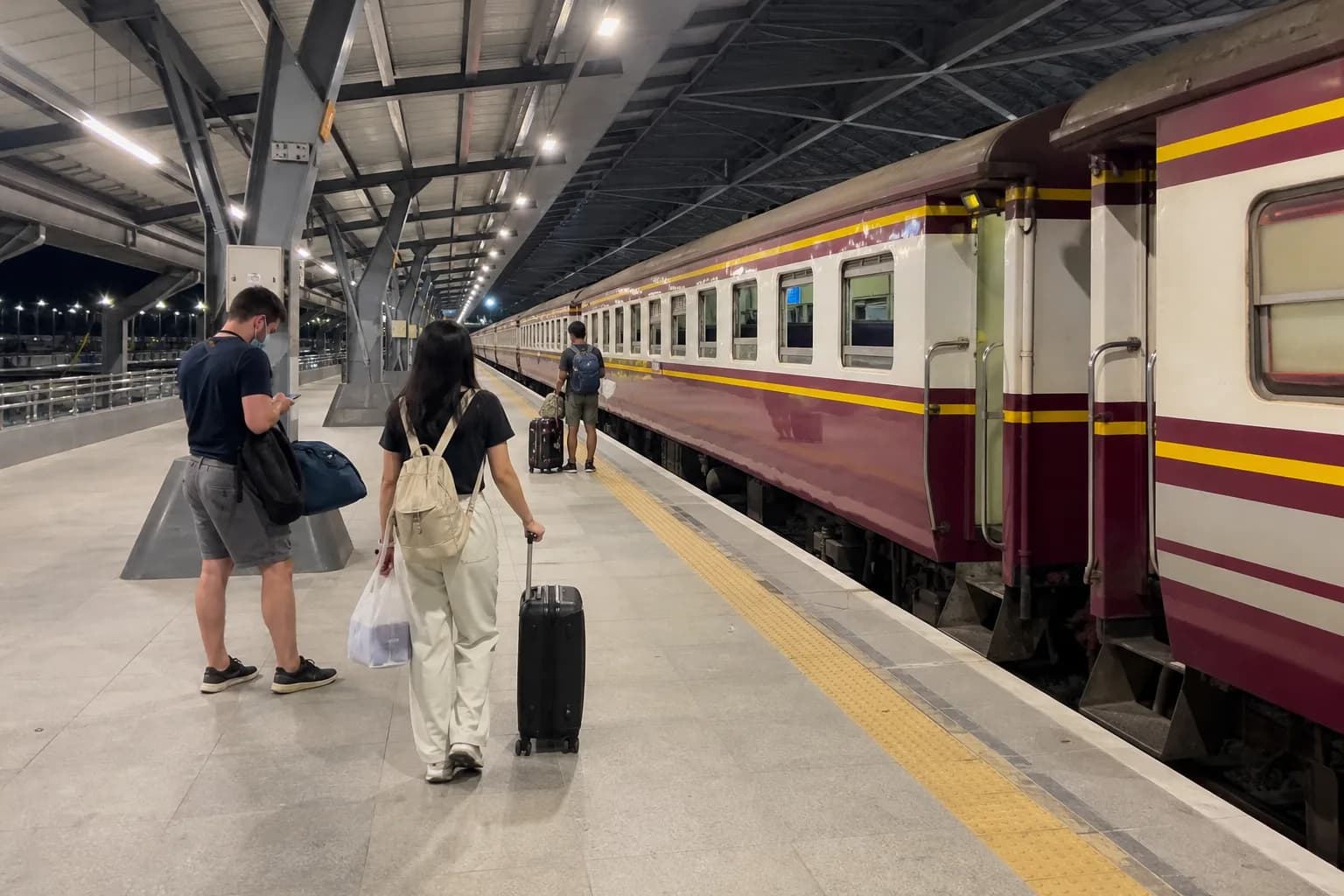
The complete train, bus and ferry journey commonly takes 12–16 hours. Sleeper options are available, which is the main reason to consider this route. Instead of spending the whole journey on a daytime coach, you can use the overnight section to cover the long rail leg before continuing towards the island.
The train itself is not a luxury service. A sleeper berth is more practical than a standard seat for an overnight journey, but facilities are basic and the toilets are functional rather than a feature of the trip. I’d keep valuables, water and an extra layer close by; carriages can feel cool even when Bangkok is hot.
From Surat Thani, combined services continue by road towards the ferry. A through-ticket is usually easier than arranging the train, bus and ferry separately because the onward connection is planned around the rail arrival. Separate tickets may offer more flexibility, but they also leave you responsible for matching every stage if the train runs late.
This is the route I’d compare when overnight travel sounds preferable to a full day on a bus. It is not the fastest option, but the sleeper can make the long distance easier to manage and may avoid paying for a separate night in Bangkok.
Bangkok to Koh Samui bus and ferry via Don Sak
The direct bus-and-ferry combination is the main budget alternative to the train. The coach travels south from Bangkok towards Don Sak, where passengers continue by ferry to Koh Samui. Raja, Lomprayah and Seatran are among the operators associated with routes in this corridor, although the exact timetable and pier depend on the service.
The typical total journey is around 11–13 hours. Through-tickets are commonly available, which is useful because the bus, pier transfer and ferry are treated as one itinerary rather than three separate bookings.
The research for this guide puts many land-and-sea options at roughly ฿600–฿1,400, with the exact fare varying by operator and date. Check what the ticket includes before comparing prices. A fare that ends at Don Sak is not directly comparable with one that includes the ferry and arrival on Koh Samui.
This route makes sense if keeping the transport cost down matters more than comfort. You spend most of the journey in a coach, and the timetable can feel long even when the connections work properly. I’d carry water and snacks rather than rely entirely on a meal stop.
The ferry is also the route’s main uncertainty. Road delays can reduce the time available before departure, and unsettled sea conditions can affect the crossing. I would avoid scheduling anything important immediately after arrival on Koh Samui.
Which route is cheapest for a given departure?
For a budget-focused departure, I’d compare a through-ticket bus and ferry via Don Sak first. Land-and-sea options commonly fall in the ฿600–฿1,400 range, although the final price depends on the operator and inclusions. The cheapest fare is only useful if it actually covers the whole route to Koh Samui.
For an evening departure, I’d look at the sleeper train via Surat Thani. The total journey commonly takes 12–16 hours, but the overnight rail section can be easier to tolerate than remaining on a coach throughout the night. Check whether the onward bus and ferry are included before booking.
For a last-minute journey, compare flights rather than assuming they are always out of reach. The research range is roughly ฿2,600–฿6,000 or more, depending on the date and sales. That is normally higher than the land-and-sea options, but the difference may be worth paying when time and reliability matter.
There is no universal cheapest route. The bus and ferry are usually the first budget comparison, the train offers an overnight alternative, and the direct flight is the clear choice for speed.
Weather, ferries and alternative gateways
Ferry conditions are worth considering when planning the land-and-sea routes. Crossings can be delayed or cancelled in rough weather, so I’d leave space between arrival on Koh Samui and any non-refundable activity or onward connection.
Some carriers also offer alternatives through Chumphon or Nakhon Si Thammarat, often shortened to NST. These routes are less common than the Surat Thani and Don Sak options, and they can change both the total journey time and the fare. Check the exact airport, station, pier and ferry included before booking.
If reliability matters more than price, I’d lean towards the direct flight. If the schedule is flexible, a bus-and-ferry or sleeper-train itinerary can reduce the transport cost, provided there is enough time for the journey and its connections.
What I’d choose
For speed, I’d take the direct Bangkok Airways flight. The air time is only 1 hour 10 minutes to 1 hour 20 minutes, and there are fewer connections to coordinate.
For the lowest practical cost, I’d first check a through-ticket bus and ferry via Don Sak. It is a long day, but the research range of roughly ฿600–฿1,400 makes it the obvious budget comparison.
For a balance between cost and comfort, I’d choose a sleeper train to Surat Thani with the onward bus and ferry included. It has more stages than flying, but it avoids spending the entire journey in a coach. I would avoid separate bookings unless the saving was clear and there was plenty of connection time.
Compare the complete journey
Include baggage, airport transfers, pier transfers and any extra hotel night before deciding which ticket is cheapest.
Use through-tickets where possible
A combined train, bus and ferry booking reduces the number of connections you have to arrange yourself.
Leave room around the ferry
Do not schedule an important same-day activity immediately after arriving on Koh Samui, particularly when sea conditions are unsettled.
How to book Bangkok to Koh Samui
I would start by checking the direct flight, then compare train-plus-ferry and bus-plus-ferry options for the same date. Operator timetables are more useful than a generic route estimate because departure times, transfer points and included services vary.
For trains, check sleeper availability and whether the onward bus and ferry are included. For buses, confirm the departure point in Bangkok, the arrival pier and whether the fare reaches Koh Samui or ends at Don Sak. For flights, check baggage and airport transfers on both ends.
The price figures in this guide are typical research ranges rather than guaranteed fares. Prices change with season, demand, operator and booking date, so I’d use them as a comparison starting point rather than a promise at checkout.
For more planning context, see our guides to Bangkok, Koh Samui and Thailand.